

From the Liquidation Cascades of 1929 to the Vault-Based Future of Programmable Finance
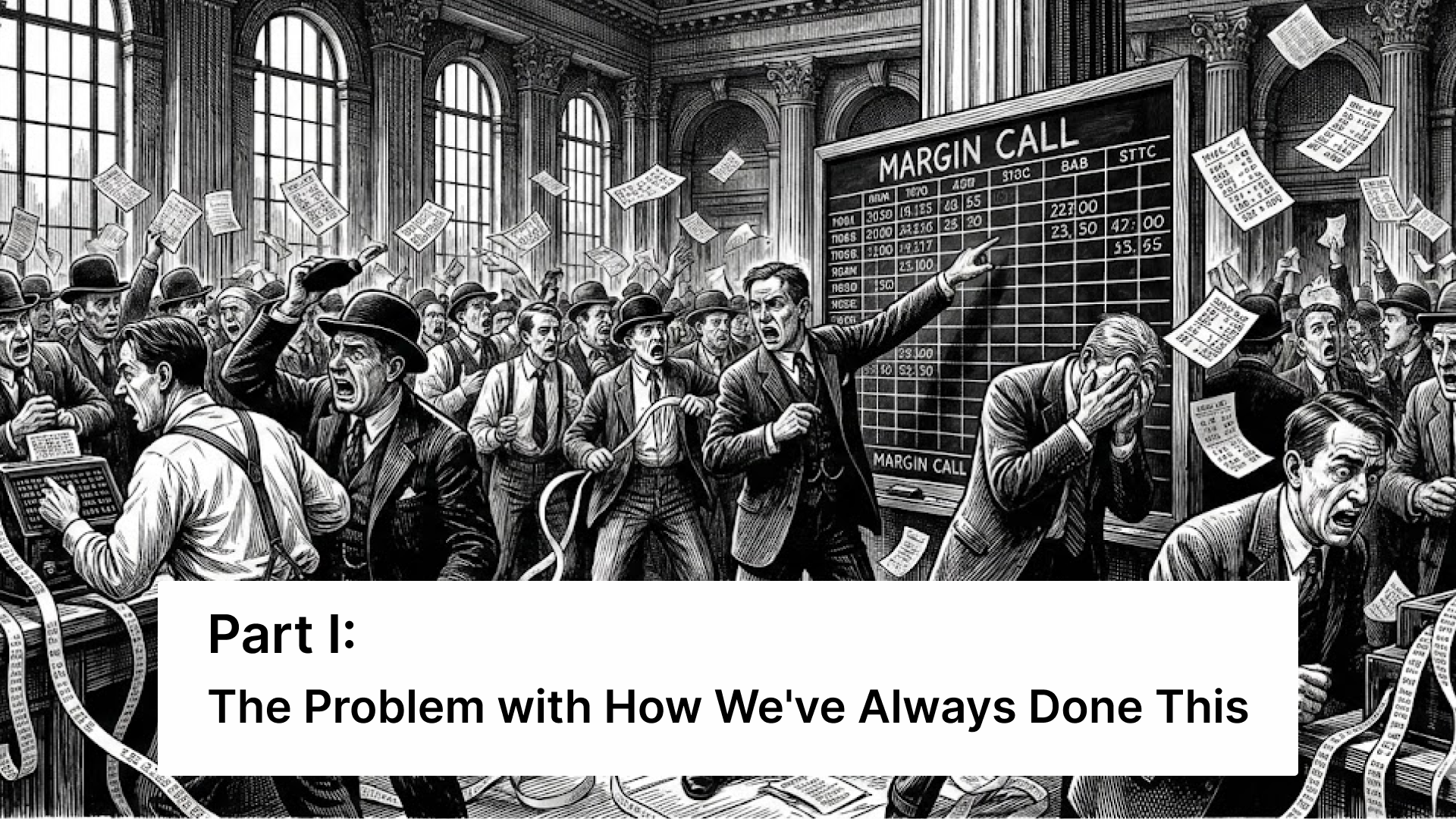
In October 1929, the mathematics of leverage revealed themselves with devastating clarity. A generation of Americans who had purchased stocks on margin (borrowing ninety cents of every dollar invested) discovered that leverage works in both directions. When prices fell ten percent, their equity didn't decline by ten percent. It was annihilated entirely.
The mechanism was simple. You put up $100. Your broker loaned you $900. You bought $1,000 worth of General Electric. When the stock dropped to $900, your equity was zero. When it dropped to $850, you owed your broker $50 you didn't have. The broker, understandably, didn't wait for this outcome. At some point before your equity reached zero, they sold your shares: forcibly, automatically, without your consent. This was called a margin call. Today we call it liquidation.
Nearly a century later, in January 2026, cryptocurrency markets witnessed the same ancient pattern play out at digital speed: $1.08 billion in liquidations within twenty-four hours, 182,729 traders force-closed from their positions. The technology had changed (blockchain instead of ticker tape, smart contracts instead of margin clerks). The underlying mathematics had not.
This is not a story about the dangers of leverage. That story has been told countless times, and telling it again would miss the more important development unfolding beneath the surface. This is a story about how a small group of protocol designers are attempting to solve a problem that has plagued financial markets since the Chicago grain traders first invented margin in the 1870s: the liquidation cascade.
The solution they've developed doesn't restrict leverage. It redesigns it entirely.
Part I: The Problem with How We've Always Done This
The Origins of a Flawed System
To understand what's being built, you first need to understand what's being replaced, and why the replacement matters.
Leverage, in its earliest forms, served a genuine economic purpose. When Chicago became America's grain hub in the 1860s, farmers faced a brutal seasonal problem: prices collapsed during harvest when supply flooded the market, then soared in spring when supplies tightened. The volatility made planning impossible.
The solution was elegant: forward contracts that let farmers lock in prices months in advance. By the 1870s, the Chicago Board of Trade had standardized these into futures contracts: agreements to buy or sell a commodity at a predetermined price on a future date. A farmer with $1,000 could control $10,000 worth of grain by posting that $1,000 as margin, a security deposit ensuring good faith.
The system worked beautifully for hedging. But it also enabled speculation. And speculation on margin contained a latent danger that would reveal itself repeatedly over the next 150 years.
In 1882, wheat speculators on the Chicago board discovered what happens when leveraged positions move against you. Margin calls cascaded through the trading floor. Traders who couldn't meet their calls had their positions liquidated, sold at whatever price the market offered. The forced selling drove prices lower. More margin calls. More liquidations. The pattern established itself: leverage amplifies both gains and losses, and liquidation mechanisms can transform orderly declines into disorderly crashes.
The Liquidation Trap
Every traditional leverage product, from those 1880s grain futures to today's cryptocurrency perpetual contracts, operates on the same basic mechanism: you post collateral, you borrow against it, and if the value of your position falls below a maintenance threshold, the system sells your assets automatically.
The mechanism sounds reasonable. If you borrow money to invest, the lender naturally wants protection against default. Automatic liquidation provides that protection. The problem is that this individually reasonable mechanism creates collectively catastrophic outcomes.
Consider a simple scenario. Bitcoin trades at $50,000. A trader posts $1,000 as margin and opens a position with 10x leverage, controlling $10,000 worth of Bitcoin. The maintenance margin is ten percent of the position value, or $1,000. The liquidation price sits at $45,000, a ten percent decline from the entry price.
Why $45,000? Because at that price, the position is worth $9,000, meaning the trader has lost $1,000, exactly their margin. Below that price, the trader owes more than they've posted. The exchange liquidates to prevent this.
Now here's the trap.
Bitcoin drops to $46,000. The trader has lost $4,000 on a notional basis (the position moved from $10,000 to $9,200), but their margin has been consumed. They're liquidated.
If this were one trader, the story would end here: a personal loss, nothing more. But what if thousands of traders have similar positions with similar liquidation prices? They're all liquidated simultaneously. The exchange must close all these positions at market prices. It needs to sell $10 million, $50 million, $100 million worth of Bitcoin in a matter of minutes.
There isn't enough buy-side demand at $46,000. Bids evaporate.
The actual liquidation fills occur at $44,000, or $43,000, or worse. Traders who expected liquidation at $45,000 instead get filled at far worse prices, losing more than their margin, sometimes owing money to the exchange. Meanwhile, the massive forced selling creates severe downward pressure on the price. Bitcoin falls further. Traders with liquidation prices at $44,000 are now liquidated too.
The cascade has begun.
The Cascade in Action
During the October 2025 cryptocurrency correction, $19 billion in positions were liquidated in a single event. The mechanics were exactly as described: an initial price decline triggered liquidations at one level, the forced selling pushed prices through the next liquidation level, triggering more liquidations, and so on. Prices fell so rapidly that cascades occurred across multiple leverage tiers, each wave of forced selling feeding the next.
The exchanges collected liquidation fees on every closed position, typically 0.5% to 1% of the position size. The market destabilized. Individual trader losses transformed into systemic crisis.
Three months later, in January 2026, another cascade liquidated $1.08 billion in twenty-four hours, with 182,729 individual traders force-closed from their positions. Some of these traders had set what they thought were conservative stop-losses. The cascade moved so fast that their stops were executed far below intended prices, or weren't executed at all before liquidation engines took over.
This pattern is not a bug in the system. It is the system. Every leverage product built on margin mechanics contains this potential energy, waiting to be released.
Why Regulation Hasn't Solved It
The traditional response to leverage disasters has been regulatory: restrict access, cap leverage ratios, require higher reserves. After 1929, the Federal Reserve gained authority to set minimum margin requirements for stock purchases. That requirement currently stands at fifty percent, meaning you cannot purchase equities with more than 2x leverage. The rule has been in effect for nearly a century.
These approaches address symptoms rather than causes. The fifty-percent margin requirement exists for stocks, yet cryptocurrency markets (which operate largely outside this regulatory framework) saw $19 billion liquidated in a single day. Why? Because traders migrate to less-regulated venues. Because new instruments emerge that embed leverage without touching traditional margin. Because the fundamental architecture of liquidation-based leverage remains unchanged regardless of what ratio regulators permit.
The pattern has repeated across every era of financial innovation:
Margin buying in the 1920s led to the 1929 crash and subsequent Federal Reserve regulation. The leverage didn't disappear; it migrated to other instruments and venues.
Portfolio insurance and program trading in the 1980s (sophisticated strategies that embedded leverage through options and futures) led to Black Monday in 1987 and the introduction of circuit breakers. The leverage adapted again.
Leverage in mortgage derivatives (collateralized debt obligations and credit default swaps) led to the 2008 financial crisis and the Dodd-Frank Act. The CDS market had grown to a notional value exceeding $60 trillion by 2007, with leverage embedded throughout the system in ways regulators barely understood.
Cryptocurrency leverage since 2017 has followed the same pattern: innovation, excess, crisis, calls for regulation. But here the regulatory response has been slower, the innovation faster, and the cycles more compressed. The industry has experienced multiple billion-dollar liquidation events without meaningful structural change.
Each crisis produced new rules. Each new era produced new ways to access leverage. The cycle continued because regulation addresses leverage ratios while leaving the underlying liquidation mechanism untouched. You can require 50% margin instead of 10% margin, but you're still building on a foundation where forced selling amplifies price movements.
What if the answer isn't restricting leverage, but redesigning it?
Part II: BTCjr and the Elimination of Liquidation Risk
A Different Architecture
Fragments Protocol, through its BTCjr implementation, represents a fundamentally different approach to leverage. Rather than masking leverage risks through opacity and centralized gatekeeping, it distributes risk transparently, and eliminates the liquidation mechanism entirely.
The core insight is that volatility is a property that can be separated from an asset and redistributed. Bitcoin's price movements contain a certain amount of volatility. That volatility can be split, with some participants absorbing more of it and others absorbing less.
The protocol works by creating two perpetual tranches from a single underlying asset: a senior tranche (BTCsr) that absorbs less volatility, and a junior tranche (BTCjr) that absorbs more. Holding both tranches together, in the right proportions, is mathematically equivalent to holding the underlying Bitcoin. The tranches represent the same economic exposure, just distributed differently.
But separated, each tranche exposes holders to different volatility profiles.
BTCsr targets approximately 0.6-0.8x Bitcoin volatility. If Bitcoin moves 10%, BTCsr moves roughly 6-8%. This is suitable for participants who want Bitcoin exposure but find its native volatility excessive: perhaps institutional allocators with risk budgets, or individuals seeking moderated exposure.
BTCjr targets approximately 1.2-1.4x Bitcoin volatility. If Bitcoin moves 10%, BTCjr moves roughly 12-14%. This is suitable for participants seeking amplified exposure: the functional equivalent of leverage, but achieved through a completely different mechanism.
The critical innovation: there is no liquidation mechanism. Positions cannot be forcibly closed. Ever.
The Mechanics of Perpetual Tranching
To understand why liquidation isn't necessary, you need to understand how the tranching actually works.
The protocol uses fixed-term tranches: contracts that mature into the underlying asset after a defined period (for example, four weeks). By continuously rotating maturing tranches out and fresh tranches in, it creates perpetual exposure. You can hold BTCjr indefinitely, even though the underlying mechanics involve discrete maturation events.
The senior tranche absorbs losses last. In a market decline, junior tranche holders bear the initial impact. Their tranche value falls faster than the underlying asset. Senior tranche holders are protected until the junior tranche's value is substantially depleted.
The junior tranche captures gains first. In a market rise, junior tranche holders benefit disproportionately. Their tranche value rises faster than the underlying asset.
This is functionally similar to traditional leverage in terms of outcome: BTCjr holders get amplified exposure to Bitcoin movements. But the mechanism is completely different. There's no borrowed money. There's no margin account. There's no maintenance threshold. There's no liquidation price.
How It Works Without Liquidations
The system achieves this through proportional redemption. If you own one percent of BTCjr tokens, you can always redeem that one percent for your proportional share of the underlying collateral. The collateral structure prevents bank-run scenarios: when someone redeems, the remaining collateral composition stays proportionally identical for everyone else.
The collateral backing each tranche includes a mix of maturing fixed-term contracts (at different vintage dates) and raw underlying asset. When a redemption occurs, the redeemer receives their proportional share of each component. The remaining holders still hold the same composition, just smaller in absolute terms.
Consider what this means in practice.
Traditional Leverage Scenario: Bitcoin is at $50,000. A trader opens a 5x leveraged long position, posting $10,000 margin to control $50,000 of exposure. Liquidation price: approximately $42,000.
Bitcoin drops to $42,000, a 16% decline. The position is liquidated. But during the cascade, actual fill price is $41,200. The trader loses their entire $10,000 margin plus an additional $800 in slippage and fees.
Total loss: $10,800 on a position that was supposed to have a maximum loss of $10,000.
BTCjr Scenario: Bitcoin is at $50,000. A trader purchases $50,000 worth of BTCjr, providing approximately 1.3x volatility exposure (roughly equivalent to modest leverage).
Bitcoin drops to $42,000, a 16% decline. BTCjr falls approximately 21% (1.3x the underlying move) to approximately $39,500.
The trader has lost $10,500 in value, comparable to the leveraged position. But there is no liquidation. The trader can hold indefinitely. They can redeem at any time for their proportional collateral. When the market recovers, the position recovers with it.
If Bitcoin rebounds to $50,000, the BTCjr position recovers to approximately $50,000 (slightly less due to funding rate effects during the holding period). The traditional leveraged trader, liquidated at $42,000, has nothing.
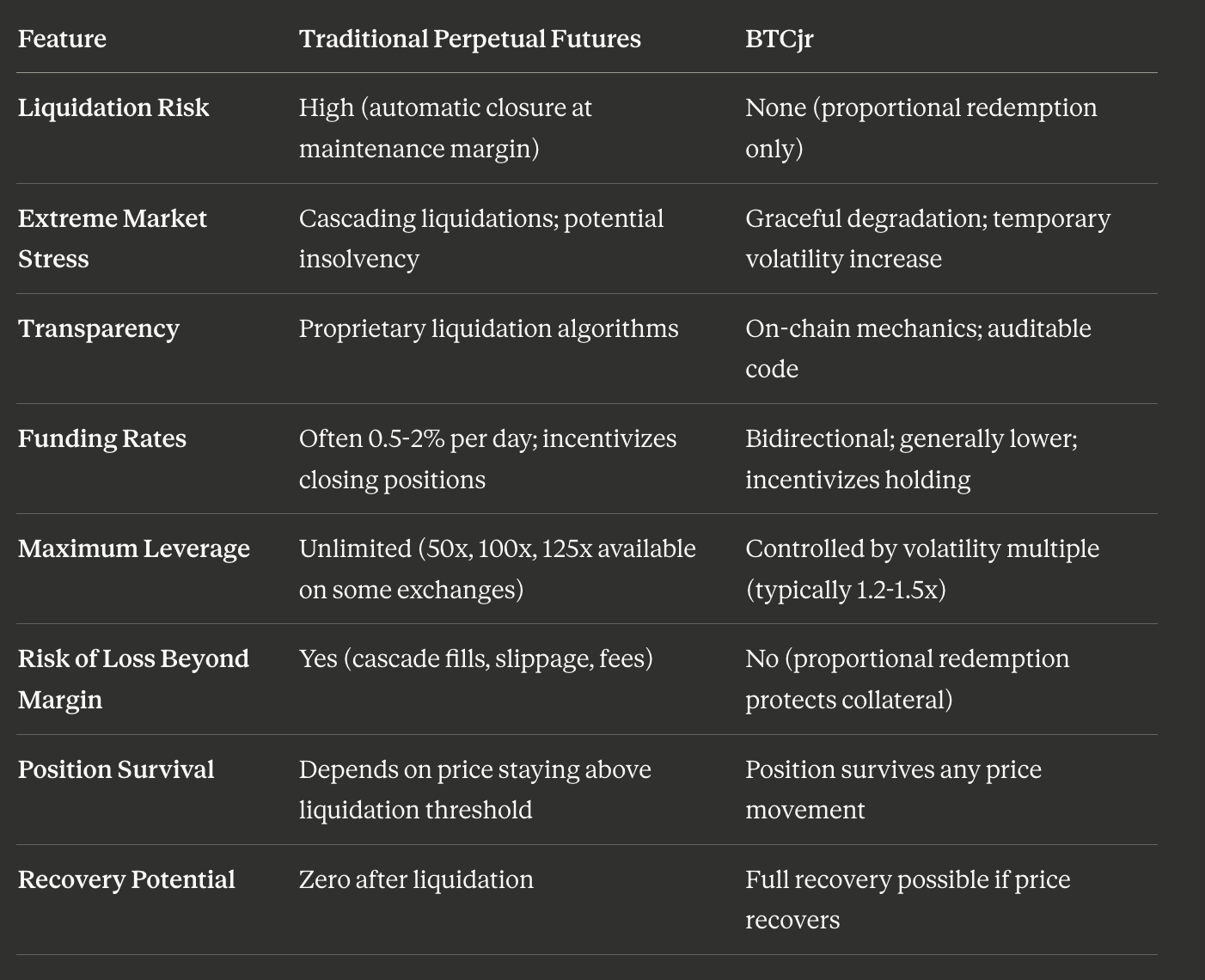
The key insight: in traditional leverage, the liquidation mechanism itself creates catastrophic losses. The cascade amplifies individual mistakes into systemic events. The exchange's protective mechanism becomes the instrument of destruction.
Remove the mechanism, and you remove the catastrophe.
The Mechanics of Stability
The protocol maintains its target volatility profile through several mechanisms that operate continuously and transparently.
Bidirectional Funding Rates
When demand for BTCjr causes the actual volatility multiple to diverge from target, a daily funding rate transfers value between tranches.
If BTCjr becomes over-capitalized relative to target (meaning too much money is flowing into the junior tranche), value flows from BTCjr holders to BTCsr holders. This reduces the attractiveness of BTCjr relative to BTCsr, incentivizing capital to rebalance.
If BTCsr becomes over-capitalized, the flow reverses.
This mechanism differs fundamentally from perpetual futures funding rates. In perpetual futures, funding rates often reach 0.5% to 2% per day during periods of extreme market sentiment. These rates effectively penalize holding the position, incentivizing traders to close. The funding mechanism works against position stability.
Fragments' bidirectional rates incentivize holding whichever position has less demand. The system rewards participants who provide balance rather than penalizing those who create imbalance.
Automatic Rebalancing
Weekly rotations of maturing tranches automatically recalibrate the system toward target ratios. As fixed-term contracts mature into raw underlying asset, they're replaced with fresh contracts that restore the intended volatility profile.
This is systematic and transparent, executed by smart contract logic rather than hidden in proprietary exchange algorithms. Anyone can audit the rotation schedule, the rebalancing calculations, and the current state of the collateral pool.
Graceful Degradation
The protocol was designed to "bend rather than break" during extreme volatility. In normal conditions, rotations occur weekly: maturing tranches are exchanged for fresh tranches to maintain perpetual exposure and the target volatility multiple.
But what happens in a hypothetical scenario where rotations halt due to capital insufficiency, where volatility is so extreme that there isn't enough capital to maintain normal operations?
In traditional systems, this scenario triggers emergency measures, liquidations, or insolvency. In Fragments, the senior tranche simply becomes temporarily more volatile.
Here's why: the senior tranche's collateral includes a mix of fixed-term senior contracts and raw underlying asset. If rotations halt, the fixed-term contracts continue to mature, but instead of being replaced with new contracts, they convert to raw Bitcoin in the collateral set, and BTCsr now holds more direct Bitcoin exposure and less structured product exposure. Its volatility increases toward 1.0x (the native Bitcoin volatility) rather than its target 0.7x.
This is suboptimal: BTCsr holders wanted reduced volatility, and they're getting more than expected. But there's no insolvency, no cascading liquidations, no bank run. Just temporary increased volatility.
When rotations resume, the system normalizes. Fresh contracts replace raw Bitcoin in the collateral set. Volatility multiples return to target.
The protocol uses a water-and-ice metaphor to explain this: imagine a voucher redeemable for ice in a freezer. If refrigeration halts (rotations halt), the ice melts into water. Your voucher is still redeemable, now for a mix of ice and water instead of pure ice. When refrigeration resumes, the water refreezes.
The system prefers temporary volatility over any condition that could cause insolvency or force permanent dysfunction. Bend, don't break.
The Comparison That Matters

Part III: The Coming Infrastructure Layer
From Single Tokens to Composable Strategies
BTCjr represents a breakthrough in how individual leverage products can be designed. A leverage instrument without liquidation risk is genuinely novel; nothing in traditional finance offers this combination of amplified exposure and position survival.
But the more significant development lies in what becomes possible when this architecture is combined with emerging infrastructure layers. Specifically: the vault systems being built by protocols like Morpho, and the leverage token frameworks emerging from Seamless Protocol.
These three innovations (liquidation-free leverage from Fragments, sophisticated vault infrastructure from Morpho, and composable strategy packaging from Seamless) are developing independently. Their convergence points toward something that doesn't yet exist but seems increasingly inevitable.
To understand where this is heading, we need to examine each infrastructure layer in detail.
Vaults: The Foundation of Noncustodial Asset Management
A vault, in the DeFi context, is a programmable, noncustodial strategy that users can opt into. Think of it as a smart contract that allocates deposits across different opportunities: without intermediaries, without custody transfer, and with complete transparency.
The closest analogy in traditional finance is an ETF or managed account, but with crucial differences. In a traditional fund structure, you invest in the fund, the fund owns the assets, you own shares in the fund, and the fund manager has custody and control. There are legal wrappers, lock-up periods, redemption windows, and minimum investments. You can only deposit and withdraw with the involvement of the fund manager.
In a vault structure, you deposit assets into a smart contract that is immutable and controlled by no person or entity. You maintain full custody; the assets never leave your control in the traditional sense. The vault automatically allocates your deposit based on predefined rules. You can withdraw instantly and permissionlessly at any time without relying on counterparties.
Morpho, one of the leading lending protocols, has developed a vault architecture that enables something previously impossible in DeFi: diverse risk profiles within a single system.
The One-Size-Fits-All Problem
Traditional DeFi lending pools force all users into a one-size-fits-all risk profile. If you deposit into a pool that lends against multiple collateral types, you're exposed to the risk of every collateral type in that pool.
Consider a typical multi-asset lending pool. It accepts deposits and lends against collateral including wstETH, WBTC, LINK, USDT, sDAI, and a dozen other assets. As a depositor, you're exposed to the risk of each collateral type. If the protocol's assumptions about LINK's liquidity prove wrong during a crisis, you bear that risk, even if you specifically wanted to avoid exposure to mid-cap altcoins.
There's no option to say "I'll lend against staked ETH derivatives but not against volatile governance tokens." The pool is the pool. Take it or leave it.
Morpho's Solution: Isolated Markets and Curated Vaults
Morpho solves this through a two-layer architecture.
The base layer consists of isolated lending markets: discrete pools where one specific collateral type backs one specific loan asset. A wstETH/USDC market. A WBTC/DAI market. Each market has its own parameters, its own risk profile, and its own liquidity.
The vault layer sits on top, aggregating these isolated markets into user-friendly products. Each vault has a unique risk profile determined by which markets it lends to. A conservative vault might lend only against wstETH collateral. A more aggressive vault might lend against a broader set of liquid staking derivatives. Users choose vaults that align with their risk appetite.
The December 2025 launch of Morpho Vaults V2 extended this architecture significantly, introducing capabilities crucial for institutional adoption.
Multi-Dimensional Risk Caps
Curators can now set both absolute caps (a fixed asset amount) and relative caps (a percentage of the vault's total assets) across multiple risk dimensions simultaneously.
A vault might implement rules like: "Maximum total exposure to stETH as collateral: $15 million (absolute cap). Maximum allocation to any single market using a new pricing methodology: 20% (relative cap). Maximum exposure to any single market: 30% (relative cap)."
This allows sophisticated risk policies that mirror what institutional asset managers implement (concentration limits, liquidity requirements, exposure caps) but enforced automatically by code rather than manually by compliance departments.
Configurable Role Segregation
Vaults V2 introduces a multi-role governance structure: Owners handle high-level governance decisions. Curators set risk parameters and approve market allocations. Allocators manage day-to-day capital deployment within curator-approved bounds. Sentinels provide emergency oversight and can pause operations if necessary.
This separation of duties enables institutional-grade compliance within a fully decentralized framework. An institutional user might require that allocation decisions go through an internal committee (curator role) while day-to-day execution is delegated to a specialized team (allocator role), with a separate oversight function (sentinel role) able to halt operations if parameters are breached.
In-Kind Redemptions
As a final noncustodial guarantee, users can force-deallocate assets from any adapter back to the vault's idle pool. By combining this with a flash loan, a user can always exit the vault by exchanging their vault shares for a direct position in an underlying protocol, even if the vault is illiquid.
This is a stronger guarantee than traditional funds provide. Many traditional funds have lock-up periods that prevent withdrawal during stress. Morpho Vaults guarantee exit rights at all times, regardless of market conditions. The user maintains full custody and exit rights at all times.
Seamless Protocol and the Leverage Token Framework
While Morpho provides infrastructure for sophisticated asset allocation, Seamless Protocol has developed a complementary framework: Leverage Tokens (LTs), which transform complex DeFi strategies into simple, tradable ERC-20 tokens.
The insight driving Seamless is that most DeFi leverage strategies are operationally burdensome. To run a leveraged staking position, you need to deposit collateral, borrow against it, swap the borrowed funds back into the collateral asset, deposit that, borrow again, "looping" the position to achieve your desired leverage. Then you must monitor constantly, rebalance when ratios drift, manage gas costs across numerous interactions, and hope you can unwind in time if markets move against you.
This is too complex for most users. It's also error-prone; a mistake in any step can be costly.
Leverage Tokens abstract this away entirely. Instead of manually managing a leveraged staking position, users hold a single ERC-20 token that represents the entire strategy. The token handles collateral management, borrowing logic, and rebalancing mechanics automatically.
The architecture is modular:
Lending Adapters specify which lending protocol to borrow from. Currently this includes support for Morpho, with other protocols (Aave, Compound) available for token creators to integrate. The adapter handles all protocol-specific logic.
Rebalance Adapters define the leverage mechanics: what conditions trigger rebalancing, how the position should be maintained over time, what parameters govern the strategy.
Anyone can create a tokenized strategy by combining adapters. Anyone can hold the resulting token like any other ERC-20 asset. The tokens are composable: they can be traded on DEXs, used as collateral in other protocols, or held in vaults for further strategy construction.

Part IV: The Meta-LT Thesis
Convergence
Here is where the thesis becomes interesting. We now have three separate innovations operating independently:
- Fragments Protocol has demonstrated how to create leverage exposure without liquidation risk through perpetual tranching (BTCjr, BTCsr).
- Morpho Vaults have created the infrastructure for sophisticated, risk-adjusted asset allocation with institutional-grade controls and noncustodial guarantees.
- Seamless Protocol has developed the framework for packaging complex leverage strategies into simple, composable tokens that anyone can create and trade.
Each innovation is valuable independently. Fragments gives traders a better leverage product. Morpho gives allocators better vault infrastructure. Seamless gives strategists better packaging tools.
But together, they point toward something more significant: Meta-Leverage Tokens (Meta-LTs), composite leverage products that combine multiple risk-adjusted strategies within a single vault structure, offering diversified leverage exposure without the liquidation cascades that have plagued every previous generation of leverage products.
What a Meta-LT Could Look Like
Imagine a vault that doesn't simply allocate deposits to isolated lending markets, but instead curates a portfolio of leverage tokens, each with different volatility profiles, underlying assets, and risk characteristics.
A Conservative Meta-LT might combine:
- BTCsr (senior Bitcoin tranche, approximately 0.7x volatility)
- ETHsr (senior Ethereum tranche, if Fragments extends to ETH)
- A low-leverage stablecoin yield strategy packaged as a Seamless LT
- Weight: 50% BTCsr, 30% ETHsr, 20% stablecoin yield
The resulting product would offer crypto exposure with dampened volatility, suitable for allocators who want participation in digital asset markets without the full ride. The vault curator would manage allocation weights, rebalancing as market conditions change.
An Aggressive Meta-LT might combine:
- BTCjr (junior Bitcoin tranche, approximately 1.3x volatility)
- A leveraged liquid staking derivative position (packaged as a Seamless LT)
- Emerging commodity leverage tokens (GoldJr, if developed)
- Weight: 60% BTCjr, 30% leveraged staking, 10% commodity
This would offer amplified exposure to multiple uncorrelated (or partially correlated) volatility sources. The diversification would provide some natural hedging, while the junior tranches would capture upside efficiently.
The vault curator (operating within Morpho's role-based governance framework) would manage allocation across these strategies, adjusting exposure based on market conditions, correlation dynamics, and risk parameters set at the vault level.
Critically, none of the underlying leverage tokens would carry traditional liquidation risk. The BTCjr position can't be liquidated; it survives any price movement. The BTCsr position provides stability without liquidation vulnerability. The entire Meta-LT would inherit the "bend rather than break" characteristics of its component tokens.
The GoldJr Possibility
The Meta-LT framework naturally extends to assets beyond cryptocurrency.
Consider what happens when the perpetual tranching model is applied to tokenized commodities. Gold, for instance, is increasingly available on-chain through various tokenization protocols (PAXG, XAUT, and others represent physical gold held in vaults). A GoldJr token (a junior volatility tranche on tokenized gold) would offer amplified exposure to gold price movements without the liquidation mechanics of traditional gold futures.
For traditional finance participants accustomed to gold as a portfolio hedge, GoldJr would represent something genuinely novel: a leverage instrument on a familiar asset class that cannot be liquidated during volatility spikes.
The March 2020 gold futures dislocation demonstrated how traditional leverage markets fail precisely when investors need them most. As COVID-19 panic spread, gold futures spreads blew out, liquidity evaporated, and the relationship between futures and spot prices temporarily broke down. Leveraged positions that should have been hedges instead became sources of additional risk.
A GoldJr token, by design, would maintain continuous availability even during extreme stress. You might experience higher-than-expected volatility (if the system degrades gracefully during crisis conditions), but you wouldn't face liquidation cascades.
A Meta-LT could then combine BTCjr, GoldJr, and perhaps other commodity tranches (SilverJr? OilJr?) into a single diversified leverage position. The correlation dynamics between these assets (cryptocurrency, precious metals, energy) would provide natural hedging effects, while the vault infrastructure would enable sophisticated rebalancing strategies.
The commodity tranche thesis extends further. Consider the appeal of SilverJr for industrial exposure, or OilJr for energy market participation, or even AgriJr for agricultural commodity exposure. Each would offer amplified participation in a traditional asset class through a mechanism that, unlike commodity futures, cannot be liquidated during volatility spikes.
For family offices and high-net-worth individuals accustomed to alternative asset allocation, these products would represent something genuinely new: leveraged commodity exposure with position permanence. The March 2020 oil futures debacle (when WTI crude briefly traded at negative $37 per barrel and wiped out thousands of retail positions) demonstrated how traditional commodity leverage can destroy wealth at precisely the wrong moment. A junior tranche on tokenized oil couldn't trade negative, and couldn't be liquidated; it would simply become more volatile during the stress event, then recover as conditions normalized.
The tokenization prerequisite is real: these products require liquid, reliable tokenized versions of the underlying commodities. For gold, tokenization is mature (PAXG and XAUT have years of operating history). For other commodities, tokenization infrastructure is less developed. But the trajectory is clear: more assets are being tokenized, and as they are, they become candidates for volatility tranching.
Risk Curation at Scale
The Morpho Vaults V2 architecture becomes particularly powerful in this context. The multi-dimensional cap system allows curators to manage risk across multiple vectors simultaneously:
- Maximum exposure to any single underlying asset (absolute cap preventing concentration)
- Maximum allocation to junior tranches versus senior tranches (relative cap controlling aggregate volatility)
- Maximum exposure to any single leverage token protocol (diversifying infrastructure risk)
- Concentration limits across correlated assets (preventing hidden correlation exposure)
This is the kind of sophisticated risk management that institutional asset managers employ, but implemented transparently in smart contract code, auditable by anyone, with noncustodial guarantees that traditional funds cannot provide.
The curator role becomes the bridge between DeFi innovation and institutional requirements. A curator might be a specialized risk management firm with quantitative modeling capabilities. It might be a traditional asset manager extending into digital assets. It might be a DAO with governance processes for strategy decisions.
They set strategy and manage risk, but they operate noncustodially, with execution automated through smart contracts rather than human intermediaries. Users can deposit and withdraw at will, without anyone needing to facilitate (or being able to prevent) the transactions.
Part V: The Institutional Bridge
Why This Matters Beyond Crypto
The traditional finance world has spent decades building infrastructure to manage leverage risk: margin requirements, clearinghouses, circuit breakers, regulatory frameworks. This infrastructure works, imperfectly, but it works. The question naturally arises: why would institutions care about DeFi alternatives?
The answer lies in what existing infrastructure cannot do.
Traditional leverage products require trust in intermediaries. Clearinghouses guarantee trades, but they also represent concentration risk. The 2018 Nasdaq Clearing member default demonstrated that even well-capitalized clearinghouses can face stress when counterparty positions go wrong. A failed clearinghouse can bring down an entire market.
Brokers manage liquidations, but their algorithms are proprietary. Traders cannot verify how they'll be treated during stress events. Will the broker liquidate at the mark price? Will they liquidate early to protect themselves? Will they liquidate slowly to avoid market impact, or quickly to minimize their exposure? The answers are unknowable.
Regulators provide oversight, but oversight is retrospective. Rules are written after crises, not before. By the time regulators understand a new leverage product, the product has already created exposures across the system.
The vault architecture being built in DeFi inverts these assumptions.
Guarantees from Code, Not Institutions
The guarantees are provided by audited, immutable smart contracts rather than institutional promises. The code executes the same way regardless of market conditions, regardless of counterparty relationships, regardless of whether the institution backing the product is having a bad quarter.
Transparent Mechanics
The liquidation algorithms (where they exist) are transparent and auditable. Anyone can read the code that determines how positions are managed. Anyone can verify that the rules are being followed. This is not possible in traditional finance, where liquidation engines are proprietary business logic.
Prospective Enforcement
The rules are enforced prospectively by smart contracts, not retrospectively by regulators. You know before you deposit exactly how your funds can be used, exactly what the exit mechanisms are, exactly what happens in stress scenarios. The rules don't change after the fact.
Real Concerns, Real Solutions
For an institution evaluating whether to participate in digital asset markets, these characteristics address real concerns:
Counterparty Risk
Morpho Vaults are fully noncustodial. The curator cannot abscond with funds because they never have custody. The smart contract enforces withdrawal rights regardless of what happens to the curator, the protocol team, or any other party. Compare this to traditional fund structures where investors have lost everything when fund managers proved fraudulent or incompetent.
Operational Transparency
Every allocation decision, every rebalancing event, every fee transfer is recorded on-chain and available in real-time. Compliance officers can audit exactly how funds were deployed without relying on quarterly reports or trusting self-reported data. The blockchain provides a complete, immutable, timestamped record of all operations.
Customizable Risk Controls
The timelocks, role separations, and cap systems in Vaults V2 enable institutions to implement their own governance requirements within the vault framework. A pension fund might require 72-hour timelocks before allocation changes take effect. A hedge fund might prefer more curator discretion with 24-hour timelocks. Both can be accommodated within the same infrastructure.
Exit Guarantees
The in-kind redemption mechanism ensures that users can always exit, even during extreme market conditions. This is a stronger guarantee than traditional funds provide. Many traditional funds have lock-up periods, redemption windows, and minimum investment requirements that prevent exit precisely when exit is most desired.
The Bitwise Signal
In early 2026, Bitwise Asset Management (a crypto asset manager with more than $15 billion in client assets) announced a vault curation partnership with Morpho. This represented something significant: a major institutional player choosing onchain, noncustodial infrastructure over traditional fund structures.
The move signals that the institutional bridge is being crossed, not from the crypto side reaching toward traditional finance, but from traditional finance reaching toward crypto infrastructure. The vault architecture is sufficiently mature that firms with fiduciary responsibilities are willing to deploy client assets through it.
This has implications for Meta-LT adoption. A pension fund that has already approved Morpho Vaults for yield strategies would have a template for evaluating Meta-LT products. The infrastructure risk has already been assessed; only the strategy risk requires new analysis. The marginal approval cost for a new vault strategy is lower than the initial approval cost for a new infrastructure platform.
The Curator Economy
A new economic layer is emerging around vault curation, one that may eventually rival the traditional asset management industry in sophistication, if not yet in scale.
Curators in the Morpho ecosystem function similarly to traditional fund managers: they design strategies, set risk parameters, and manage allocations. But the economics differ in important ways.
Traditional asset management carries enormous operational overhead. Back offices, compliance departments, legal teams, custody arrangements, reporting infrastructure: the operational cost of running a billion-dollar fund can consume hundreds of basis points annually. These costs get passed to investors through management fees, often 1-2% of assets under management regardless of performance.
Vault curation replaces most of this overhead with code. The back office is a smart contract. The custody arrangement is cryptographic rather than institutional. The reporting infrastructure is the blockchain itself: complete, timestamped, immutable. A curator can run a billion-dollar strategy with a team that would barely staff a traditional fund's compliance department.
This efficiency translates to lower fees for depositors. A traditional fund charging 150 basis points annually competes against a vault charging 50 basis points for comparable strategy exposure. Over a decade, that difference compounds significantly.
The curator business model also enables new kinds of specialization. A curator might focus exclusively on liquid staking derivative strategies, developing deep expertise in a narrow domain. Another might specialize in cross-chain yield optimization. Another in conservative, regulatory-compliant strategies suitable for institutional mandates.
This specialization is difficult in traditional finance, where the operational costs of running any fund are so high that narrow specialization is economically unviable. In the vault economy, a highly specialized curator can operate profitably at scale points that would be impossible for a traditional fund.
The Compliance Question
For institutional adoption to accelerate, the compliance question must eventually be resolved. How do leverage tokens, vault products, and curator roles fit within existing regulatory frameworks?
The honest answer is that no one knows yet. The SEC has issued guidance on some digital asset questions but has not addressed volatility tranching products specifically. The CFTC has jurisdiction over derivatives, and leverage tokens have derivative-like characteristics, but they're not derivatives in the traditional sense: not futures contracts, not options, not swaps. They're something new.
European regulators, through MiCA and related frameworks, are developing rules for crypto assets, but the frameworks focus primarily on tokens as securities or payment instruments, not on novel risk-transfer mechanisms.
This uncertainty creates risk for institutional adopters. A pension fund that allocates to a Meta-LT product today might find that product classified as an unregistered security tomorrow. The reputational and legal implications could be severe.
But regulatory uncertainty is a temporary condition, not a permanent one. Frameworks will eventually crystallize. The question is whether the crystallization will be favorable or hostile to the innovations described here.
The direction of travel, at least in some jurisdictions, appears favorable. Switzerland, Singapore, and the UAE have developed relatively accommodating frameworks for digital asset innovation. The UK has signaled intent to become a crypto hub. Even the US, despite enforcement-heavy approaches, has seen legislative efforts to provide clearer rules.
Institutions that engage early, while frameworks remain uncertain, accept regulatory risk in exchange for potential first-mover advantages. Institutions that wait for clarity accept the risk that, by the time clarity arrives, the market may have matured and the advantages of early entry may have dissipated.
This is a judgment call, not an obvious decision. Different institutions will make different choices based on their risk appetite, their regulatory relationships, and their strategic priorities.
Part VI: The Risks That Remain
What Hasn't Been Solved
This analysis would be incomplete without acknowledging the risks that persist, even in redesigned leverage architectures.
Smart Contract Risk
Every DeFi protocol operates on code, and code contains bugs. The protocols discussed here have undergone multiple security audits. Morpho Vaults V2 was audited by Spearbit, Blackthorn, Chainsecurity, and Zellic, with additional formal verification by Certora. Fragments Protocol has been audited by leading security firms. Bug bounties of $1.5 million and higher provide ongoing security incentives.
But audits reduce risk; they don't eliminate it. A critical vulnerability in vault infrastructure could affect all deposits across all strategies. The composability that makes Meta-LTs possible also means that a bug in any component layer could cascade through the system.
Correlation Risk
Meta-LT products that combine multiple leverage tokens create correlation exposure. During severe market stress, correlations between crypto assets tend to increase, and the diversification benefits assumed under normal conditions may not hold when they matter most.
This is a familiar problem in traditional finance, sometimes called the "correlations go to one" phenomenon during crises. The assets that seemed uncorrelated during calm markets become correlated during panic, as forced selling across all asset classes creates common downward pressure.
Meta-LT curation will require sophisticated correlation modeling and stress testing. The vault infrastructure enables implementing correlation-based risk limits, but someone has to set those limits correctly.
The 2008 financial crisis provided a brutal lesson in correlation dynamics. Portfolios that appeared diversified (holding mortgages, corporate bonds, equities, and commodities) proved to be concentrated in a single factor: credit conditions. When credit conditions deteriorated, every asset class fell simultaneously. The diversification was illusory.
Meta-LT curators will need to understand what factors actually drive their component token correlations. Is BTCjr correlated with GoldJr because both respond to risk-off sentiment? Or does BTCjr correlate more with tech equities while GoldJr correlates with inflation expectations? The answers matter for portfolio construction.
The good news is that the transparency of DeFi infrastructure makes this analysis easier than in traditional finance. Every transaction, every price movement, every rebalancing event is recorded on-chain with timestamps. Correlation analysis can draw on complete historical data, not the sampled, delayed, and sometimes manipulated data that traditional finance contends with.
Liquidity Risk
While vault architectures guarantee exit rights in principle, execution still depends on market liquidity. A user forcing an in-kind redemption during a crisis may receive underlying positions at unfavorable valuations. The mechanisms prevent being trapped, but they don't prevent losses from illiquidity.
If a Meta-LT holds BTCjr and the BTCjr secondary market becomes illiquid during a crisis, the redemption mechanism still works, but the user receives BTCjr tokens they may struggle to convert to other assets at fair value.
Regulatory Uncertainty
The regulatory status of leverage tokens, vault products, and curator roles remains undefined in most jurisdictions. Products that are permissible today may face restrictions tomorrow. The SEC has not provided clear guidance on volatility tranching products. European regulators are still developing frameworks for DeFi products.
Institutional adoption will depend partly on regulatory clarity that doesn't yet exist. A pension fund's compliance committee may be comfortable with the technical risks but uncomfortable with the regulatory uncertainty.
Volatility Multiple Drift
BTCjr and similar products target specific volatility multiples, but these multiples adjust dynamically based on supply and demand. During periods of high demand for junior tranches, actual volatility exposure may exceed targets. During periods of low demand, exposure may fall below targets.
Traders accustomed to fixed leverage (a 3x perpetual is always 3x, until liquidation) must understand that volatility tranching is different. The leverage equivalent varies based on market conditions and capital flows.
The Difference from Traditional Risk
These risks are real. They should inform allocation decisions and position sizing. But they differ qualitatively from the risks in traditional leverage products.
Traditional leverage fails through cascading liquidations, a self-reinforcing feedback loop that amplifies losses beyond what any individual trader anticipated. The system itself becomes the adversary, forcibly closing positions at the worst possible moments.
The redesigned architecture fails differently. Smart contract bugs, correlation breakdowns, liquidity constraints: these are risks, but they're not feedback loops. They don't inherently amplify themselves. A bug affects everyone simultaneously but doesn't create cascade dynamics. Illiquidity affects exit prices but doesn't force exits.
This is the distinction that matters: the new architecture contains risks but doesn't contain the specific mechanism (the liquidation cascade) that has caused every major leverage crisis for the past century.

Part VII: The Shape of What's Coming
A Possible Future
If the trajectory described here continues, what emerges over the next several years?
2026-2027: Foundation Phase
Leverage tokens like BTCjr gain adoption among crypto-native traders seeking alternatives to perpetual futures. The value proposition (leverage without liquidation) proves compelling to traders who have been liquidated in previous cycles. Vault infrastructure matures as Morpho and others deploy V2 systems and accumulate operating history. Early experiments with multi-token strategies provide data on correlation dynamics and rebalancing approaches.
2028-2029: Institutional Entry
Major asset managers begin offering vault-based products to clients, starting with yield strategies and expanding to structured products. The path follows a familiar institutional adoption pattern: first, the most innovative allocators (family offices, crypto-native hedge funds) enter. Then, as track records accumulate and regulatory clarity improves, larger allocators follow: endowments, pension funds, insurance companies.
Regulatory frameworks start crystallizing around leverage tokens and curator roles, providing the clarity institutions need. Perhaps the SEC issues guidance that leverage tokens are not securities if they meet certain criteria. Perhaps European regulators classify them under a new DeFi-specific framework. The specifics matter less than the fact of clarity.
Meta-LT products emerge, combining multiple volatility tranches within sophisticated vault structures. The first successful Meta-LTs attract attention and imitation. Competition drives innovation in curator strategies, fee structures, and risk management approaches. Traditional finance firms partner with DeFi protocols rather than building competing infrastructure, recognizing that years of battle-tested code represent a moat that's expensive to replicate.
2030 and Beyond: Infrastructure Standard
The vault architecture becomes a standard for asset curation broadly, not just for leverage products, but for any strategy requiring sophisticated allocation and risk management. Traditional finance firms build products on crypto rails not because they're crypto products, but because the infrastructure is superior (more transparent, more efficient, better guarantees). The liquidation cascade becomes a historical artifact, like bucket shops and open outcry trading floors: remembered, but no longer practiced.
This is speculative, of course. Regulatory headwinds could slow adoption indefinitely. Technical vulnerabilities could erode confidence. Competing architectures could emerge that supersede what's being built today. The future doesn't follow straight lines.
But the direction is clear. The problem with leverage has never been leverage itself; it's been the liquidation mechanism that transforms individual losses into systemic crises. That mechanism is now being designed out of the system entirely.
The Lesson of History
Every major financial innovation follows a pattern: initial excess, crisis, regulatory response, gradual maturation. Stock margin buying in the 1920s followed this pattern. Derivatives in the 1980s and 1990s followed it. Cryptocurrency leverage since 2017 has been following it.
What's different now is that the maturation phase includes not just regulatory response, but architectural redesign. The protocols being built today don't merely accept regulation; they encode better properties into the system itself. Transparency, noncustodial guarantees, elimination of liquidation cascades: these aren't regulatory requirements imposed from outside. They're design choices embedded in the infrastructure.
Ray Dalio has written extensively about the debt cycle and how leverage amplifies both booms and busts. His insight is that the cycle itself is inevitable; what matters is how societies manage it. Traditional management has relied on central banks, regulation, and occasional bailouts: reactive measures that address crises after they occur.
The emerging alternative manages the cycle differently: by building financial infrastructure that bends rather than breaks, that degrades gracefully rather than catastrophically, that distributes risk through transparent mechanisms rather than concentrating it in opaque institutions.
This is not utopia. The new architecture has its own failure modes, its own risks, its own potential for misuse. Some of those failure modes we can anticipate; others will surprise us. But the architecture represents genuine evolution: not just new products on old rails, but new rails entirely.
Conclusion: The Redesign of Risk
Leverage will never disappear. Traders will always seek it; markets will always offer it. The question is not whether leverage will exist, but how it will be structured.
For nearly two centuries, we've structured leverage around liquidation: the forced sale of assets when collateral falls below maintenance thresholds. This structure has produced countless crises, ruined generations of traders, and required ever-more-complex regulation to manage. The 1929 crash. The 1987 crash. The 2008 crisis. The cryptocurrency liquidation cascades of 2020, 2021, 2022, 2025, and 2026. The pattern repeats because the architecture permits it.
BTCjr and the Fragments Protocol demonstrate that another structure is possible. Leverage exposure without liquidation risk. Volatility tranching without cascading failures. Transparent, auditable mechanics without proprietary algorithms.
The vault infrastructure being built by Morpho provides the foundation for sophisticated, institutional-grade asset management on these new rails. Risk curation, role segregation, noncustodial guarantees: all the requirements for institutional adoption, implemented in code rather than legal agreements.
The leverage token framework from Seamless Protocol shows how complex strategies can be packaged into simple, composable instruments. Anyone can create a tokenized strategy; anyone can hold it like any other asset.
The convergence of these technologies points toward Meta-LTs, composite leverage products that combine multiple risk-adjusted strategies, managed by curators operating within sophisticated governance frameworks, with guarantees enforced by smart contracts rather than institutions.
This is the redesign of risk itself. Not eliminating risk (that's neither possible nor desirable) but restructuring it. Moving from systems that amplify failures to systems that contain them. From opacity to transparency. From custody to code. From liquidation cascades to graceful degradation.
The history of leverage is written in crashes and crises. The future may be written differently.
This analysis examines emerging financial infrastructure as of Q1 2026. The protocols, mechanisms, and possibilities described here are evolving rapidly. Readers should consult current documentation for any developments since this writing. Nothing in this article constitutes financial advice or recommendation to purchase any asset or token.