

$AMPL as an Inflation Hedge: Why a CPI-Linked Asset Matters in 2025 & Beyond.

Thesis
Fiat inflation is a persistent, structural problem with varied causes and painful historical episodes. In a world where inflationary shocks recur, CPI-linked, on-chain monetary primitives like $AMPL offer a novel hedge: they programmatically target purchasing power rather than a nominal peg. That makes AMPL when combined with it’s DeFi tooling (wAMPL, SPOT, stAMPL, Rotation Vaults) uniquely positioned as a non-custodial, composable inflation-resistant building block for the next era of digital money.
A brief introduction to inflation and its significance
The persistent increase in the average level of prices for goods and services within an economy is known as inflation. Inflation lowers money's purchasing power over time unless money grows nominally to keep up with inflation, which is most commonly measured by the Consumer Price Index (CPI).
The significance of it
- Erosion of savings: Excessive inflation reduces real returns and deters people from saving in nominal assets.
- Price signal uni: Firms and markets are less able to plan if prices are changing quickly.
- Distributional pain: Inflation may worsen inequality and tends to hurt fixed-income households in a disproportionate manner.
- Instability and policy drag: Aggressive monetary contraction induced by persistent inflation can induce slumps.
Causes & modern drivers of inflation (evidence-based)
Inflation rarely springs from a single cause. Modern episodes reflect interacting supply, demand, and policy factors:
Monetary expansion / money supply growth. Increasing money supply faster than real output can be inflationary, a classic mechanism illustrated in extreme cases. Expectations and liquidity are impacted by central bank policies, such as having sizable balance sheets.
Fiscal stimulus and demand shocks. Demand can be increased more quickly than supply can react with large fiscal packages and income supports (especially during/after COVID stimulus).
Disturbances in the supply chain. Frailties were revealed by pandemic shutdowns, and shortages caused many goods' prices to rise.
Commodities and energy shocks. Global inflation was triggered by geopolitical events, like the invasion by Russia of Ukraine in 2022, where energy prices doubled sharply.
Pass-through of wage & input cost. Tightening of labour or shortages in inputs may cause firms to increase prices, maintaining inflation.
Price and structural expectations. Inflation expectations can prove self-fulfilling once they rise by shifting prices, wages, and contracts.
These factors combined fueled the surge in global inflation that began in 2021: supply shortages, enormous fiscal and monetary stimulus, demand for post-pandemic recovery, and subsequent energy shocks set off rates of inflation in several countries that had not been witnessed in decades. Numerous studies of post-COVID inflation have thoroughly documented this increase.
The global statistical picture
Global peak & normalization: After the COVID crisis and energy shocks, global inflation skyrocketed. IMF estimates put global inflation declining from an estimated 6.8% in 2023 to ~4.5% in 2025 as advanced economies approach their goals sooner. This implies that the 2021–2023 onwards surge in inflation reaches its acute phase but a new baseline in terms of macroeconomic requirements that need containment arrives here.

Graph shows inflation rates since January 2021, which also shows the volatility of the monthly (annualized) rates.
Country extremes ('illustrative'): Following pandemic, several countries had lengthy spells of extremely high inflation rates, while others had record price spikes (mainly commodity importers). Typical hyperinflations (Weimar German, Zimbabwean, Venezuelan) were a byproduct of fiscal and monetary disasters as well as political implosion and realized monthly or yearly stratospheric rates. They show how trust in money matters — when it collapses, real economies fracture.
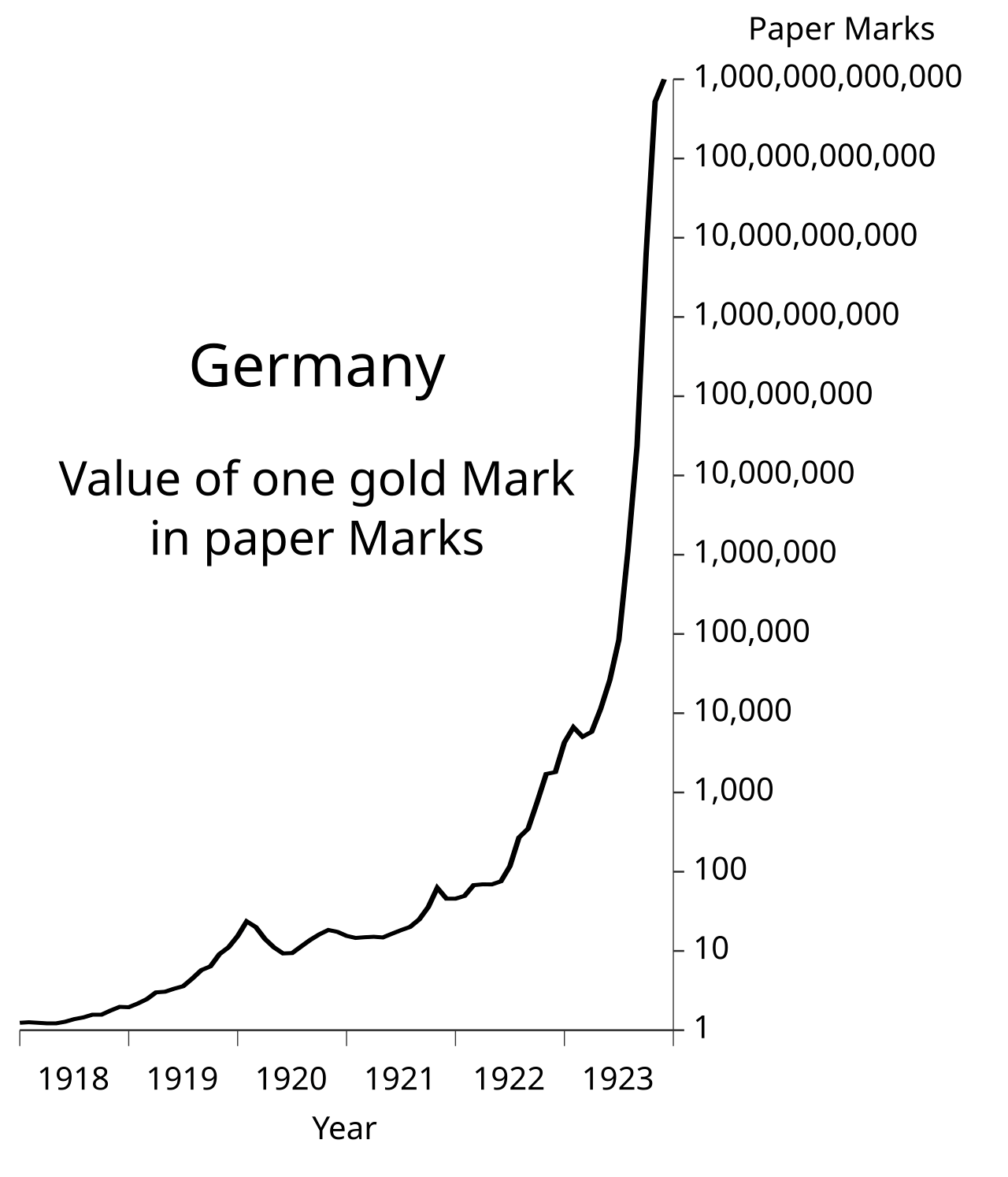
Weimar Republic hyperinflation from one to a trillion paper marks per gold mark; values on logarithmic scale.
IMF & World Bank data sources: International organizations maintain inflation databases and forecasts (World Bank CPI datasets; IMF World Economic Outlook) that show high dispersion across countries, indicating that inflation risk is both global and heterogenous.
Traditional hedges & their limits
Common inflation hedges include:
Nominal bonds with inflation indexation (TIPS, I-Bonds). Effective but issued within sovereign frameworks, subject to local availability and capital controls.
Real assets (commodities, real estate, gold). Durable but frequently costly to store or purchase and illiquid.
Fiat-pegged stablecoins. Offer illusory stability against a fiat currency but depend on central issuers (custodial risk) or weakly structured algorithmic machinery.
Bitcoin / scarce crypto. Viewed by some as “digital gold” but remains highly volatile in price terms and not designed to track purchasing power.
Each option has tradeoffs: counterparty/custody risk (fiat stablecoins), illiquidity (real assets), policy risk (sovereign indexation), or volatility (BTC). This creates room for a new primitive: on-chain, programmatic purchasing-power targeting.
$AMPL: what it is, and how its CPI target differs from other models
AMPL (Ampleforth) is an ERC-20 token that implements elastic supply: every holder’s balance is adjusted (a “rebase”) up or down when market price deviates from a predefined target. Crucially, that target is the CPI-adjusted 2019 US dollar, in other words, AMPL’s supply aims to keep purchasing power aligned with a dollar measured in 2019 prices rather than a nominal, fixed dollar amount. The Ampleforth docs describe this exact design choice and daily rebase mechanism
Key distinctions:
- Not a peg. AMPL does not promise 1 AMPL = $1 nominal; instead it targets a unit of account whose target value shifts with CPI (so the target represents real purchasing power anchored to 2019). This avoids the fragility of hard pegs while aiming for long-run purchasing power stability.
- Supply adjusts, not price. Rather than using reserves or collateral to hold price at a level, AMPL changes token quantity across all wallets, volatility is redistributed into supply rather than price. That changes the economics of holding and pricing risk.
How CPI-linking makes AMPL resilient to fiat inflation
Automatic rebase toward real value: If USD purchasing power (CPI) declines (i.e., fiat inflation rises), AMPL’s CPI-adjusted target rises nominally, the protocol will expand supply if market price is below the new target, adjusting user balances so that AMPL holders maintain relative claim over the network’s unit of account. In plain terms: AMPL’s target anticipates and moves with fiat inflation, so holding AMPL preserves exposure to a consistent basket of goods priced in 2019 dollars.
Decentralized and permissionless execution: This programmatic adjustment is on-chain and algorithmic, no custodial reserves or centralized management are required. That reduces counterparty risk vs. fiat-backed stablecoins and removes reliance on external balance sheets.
Composability with DeFi tooling: wAMPL, SPOT, stAMPL and Rotation Vaults allow users and protocols to integrate AMPL’s CPI-linked exposure in practical ways:
- wAMPL wraps AMPL into a non-rebasing ERC-20 to ease integration with lending protocols and exchanges.
- SPOT (senior) and stAMPL (junior) tranche exposure permits separation of stability preferences: users who want low short-term volatility can hold SPOT; risk-tolerant users can take leveraged exposure via stAMPL and earn rotation fees.
- Rotation Vaults provide liquidity, rotation mechanics, and arbitrage pathways that help maintain market functioning and enable practical swaps between AMPL and its derivatives.
Inflation expectation anchoring: By indexing to CPI, AMPL aligns expectations: holders expect the token’s purchasing power to track a common, observable price index. This reduces one vector of uncertainty unlike algorithmic stablecoins that chase a nominal peg without anchoring to real purchasing power.
Practical implications and strategies (2025 & beyond)
Long-term saving versus fiat depreciation: For depositors in high-inflation territories, AMPL can provide a digital substitute for national currency saving that depreciates rapidly. Because AMPL targets purchasing power, long-term holders avoid some of the real-value losses associated with fiat depreciation.
Denominating contracts & wages: Smart contracts, loans, or salary contracts denominated in AMPL could preserve real purchasing power over time without relying on a government to issue inflation-indexed instruments.
DeFi primitives & collateral: wAMPL enables AMPL exposure in lending markets; SPOT may function as a quasi-stable, CPI-linked collateral that’s non-custodial. That opens new product design paths for inflation-sensitive lending and savings.
Conclusion: why 2025 & beyond is the right frame
By 2025 the post-COVID inflation episode has receded from its worst peaks, but the macro lesson is clear: inflation cycles and geopolitical shocks remain a core risk for money. Traditional hedges have limits; stablecoins reintroduce counterparty risk; Bitcoin is volatile for transactional use. AMPL’s CPI-linked, on-chain approach offers a different tradeoff: programmable, permissionless preservation of purchasing power that is composable into DeFi.
That is why AMPL matters for 2025 & beyond: it provides a new monetary primitive tuned to a real economic goal (preserving purchasing power) while retaining the permissionless, composable advantages of crypto. It stands to maintain long-term usefulness and become a standard unit of account in on-chain economies.